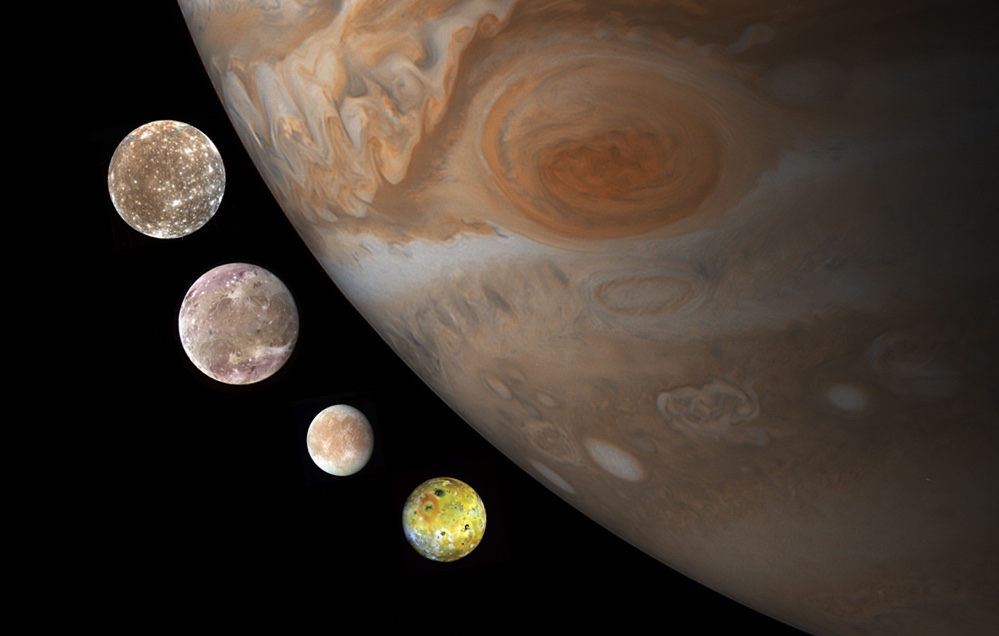
Jupiter, the largest planet in our solar system, is accompanied by an extraordinary collection of moons, each with unique characteristics. Among these, Europa and Ganymede have captivated scientists and space enthusiasts for decades due to evidence suggesting vast subsurface oceans beneath their icy crusts. These hidden oceans are not only key to understanding the moons themselves but also hold profound implications for astrobiology, planetary science, and the search for extraterrestrial life. Studying these worlds helps answer fundamental questions about habitability, planetary evolution, and the diversity of oceanic environments beyond Earth.
Europa: A Frozen World with Liquid Potential
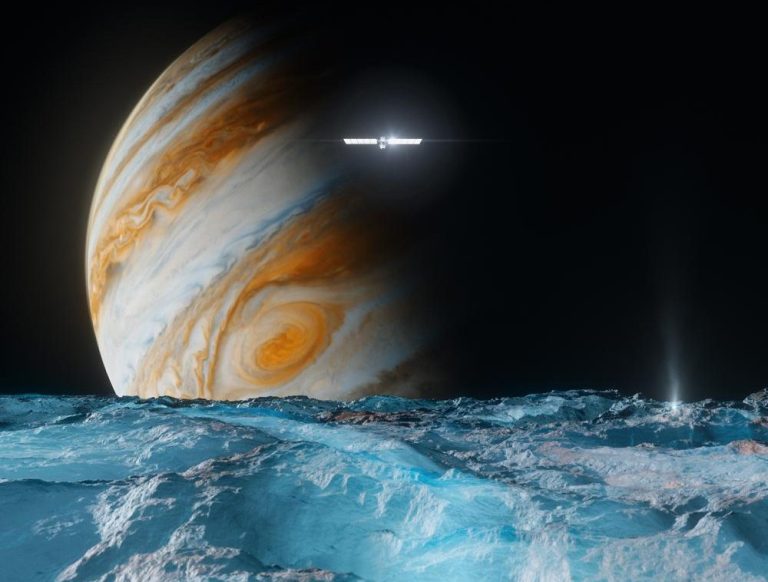
Europa, slightly smaller than Earth’s Moon, has been the focus of intense scientific interest due to its smooth, icy surface and signs of tectonic activity. Observations from the Galileo spacecraft and subsequent telescopic studies indicate that beneath Europa’s ice shell, which ranges from 10 to 30 kilometers thick, lies a global saltwater ocean.
Evidence for Subsurface Oceans
Several lines of evidence support the existence of Europa’s hidden ocean:
-
Surface Features: Long linear fractures, ridges, and chaotic terrain suggest ice movement driven by tidal forces.
-
Magnetic Field Observations: Galileo detected an induced magnetic field, indicating a conductive layer consistent with a salty liquid ocean beneath the ice.
-
Plumes of Water Vapor: Hubble Space Telescope observations suggest intermittent water vapor plumes, which could provide direct sampling opportunities for future missions.
| Feature | Europa | Ganymede |
|---|---|---|
| Diameter | 3,121 km | 5,268 km |
| Ice Shell Thickness | 10–30 km | 150 km (approx.) |
| Ocean Depth | 60–150 km | ~100 km |
| Magnetic Field | Induced by Jupiter | Intrinsic |
| Tidal Heating | Strong | Moderate |
| Potential for Life | High, due to shallower ocean & energy flux | Moderate, deep ocean & magnetic protection |
Tidal Heating and Habitability
Europa’s orbit around Jupiter generates strong tidal forces, flexing its icy shell and heating its interior. This tidal heating likely keeps the subsurface ocean from freezing entirely and may drive hydrothermal activity on the seafloor. Such energy sources, combined with chemical nutrients from rock-water interactions, create conditions analogous to Earth’s deep-sea hydrothermal vents, which support diverse ecosystems independent of sunlight.
Energy Sources Beneath the Ice
Tidal heating generated by Jupiter’s immense gravitational pull is a crucial energy source for both Europa and Ganymede. On Europa, flexing of the ice shell produces heat that prevents the ocean from freezing completely, while on Ganymede, residual radiogenic decay in the core and tidal forces sustain long-term oceanic stability. Understanding these energy dynamics is essential to assessing each moon’s habitability and the potential for chemical processes that could support life.
Ganymede: A Magnetically Active Ocean World
Ganymede, the largest moon in the solar system, surpasses even Mercury in size and presents a fascinating case for oceanic research. Unlike Europa, Ganymede possesses its own intrinsic magnetic field, detected by the Galileo mission, providing unique insights into its internal structure.
Internal Structure and Ocean Layers
Ganymede is believed to contain multiple layers of ice and water:
-
Surface Ice: A solid crust displaying grooved terrain formed by tectonic stress.
-
Subsurface Ocean: A global ocean beneath the ice shell, estimated to be 100 kilometers deep, making it the largest known ocean in the solar system.
-
Rocky Mantle and Core: Layers beneath the ocean provide heat through residual radiogenic decay and tidal interactions with Jupiter, sustaining liquid water over geological timescales.
Implications for Life
While Ganymede’s ocean lies deeper than Europa’s, the potential for life exists if energy gradients and chemical nutrients are sufficient. The presence of a magnetic field could protect the ocean from charged particle radiation, creating a more stable environment for potential life forms.
Astrobiological Significance
Subsurface oceans on Europa and Ganymede represent some of the most promising locations for extraterrestrial life within our solar system. Scientists consider three primary criteria for habitability:
-
Liquid Water: Both moons possess extensive oceans beneath their ice layers.
-
Energy Sources: Tidal heating, potential hydrothermal vents, and chemical gradients provide energy that could support metabolic processes.
-
Chemical Ingredients: Rock-water interactions may release essential elements, including carbon, nitrogen, and sulfur, creating the potential for prebiotic chemistry.
The combination of these factors places Europa and Ganymede at the forefront of astrobiological research, offering opportunities to study life in environments fundamentally different from Earth’s surface ecosystems.
Comparisons with Earth’s Oceans
Europa’s and Ganymede’s oceans may be more extreme than Earth’s, with high pressures, low temperatures, and limited sunlight penetration. Studying these environments can expand our understanding of life’s adaptability and inform the search for biosignatures in other planetary systems. Earth analogs, such as subglacial lakes in Antarctica or deep-sea hydrothermal vents, provide insights into potential biological processes in icy extraterrestrial oceans.
Space Missions Targeting Jupiter’s Moons
Exploration of these moons is entering a new era, with planned missions aiming to characterize ice thickness, ocean properties, and potential habitability.
Europa Clipper
NASA’s Europa Clipper, scheduled for launch in the mid-2020s, will perform detailed reconnaissance of Europa’s ice shell and subsurface ocean. Key objectives include:
-
Mapping surface composition and geological features.
-
Measuring ice thickness and ocean depth using radar sounding instruments.
-
Characterizing plume activity for potential in situ sampling opportunities.
-
Assessing chemical ingredients and energy sources necessary for life.
Jupiter Icy Moons Explorer (JUICE)
The European Space Agency’s JUICE mission focuses on Ganymede, Europa, and Callisto. With a launch planned in the mid-2020s, JUICE will study:
-
Ganymede’s ocean, magnetic field, and ice shell structure.
-
Surface composition, including potential signs of subsurface interactions.
-
Jupiter’s influence on the moons’ radiation environments and habitability.
Future Landers and Submersibles
Concepts for future missions include landers capable of penetrating ice or deploying submersibles into subsurface oceans. While technically challenging, such missions could directly search for biosignatures and provide unprecedented insight into alien marine environments.
Exploring the Oceans: Missions and Technologies
Future exploration of these hidden oceans will rely on advanced technologies such as ice-penetrating landers, autonomous submersibles, and high-resolution radar. These instruments aim to map the ocean depth, detect hydrothermal activity, and search for biosignatures. Successfully navigating Jupiter’s radiation belts and the thick ice crusts will require unprecedented engineering precision, making these missions both scientifically ambitious and technologically groundbreaking.
Challenges in Exploring Subsurface Oceans
Exploration of Europa and Ganymede presents significant technical and scientific challenges:
-
Thick Ice Crusts: Penetrating tens to hundreds of kilometers of ice requires advanced robotics and autonomous systems.
-
Radiation Environment: Jupiter’s intense radiation belts pose risks for spacecraft electronics and instrumentation.
-
Remote Operations: Communication delays and limited access necessitate highly reliable, autonomous mission design.
-
Contamination Risk: Planetary protection protocols are critical to avoid introducing Earth microbes to these potentially habitable environments.
Despite these challenges, the scientific payoff justifies investment, with the potential to transform our understanding of life beyond Earth.
Broader Implications for Planetary Science
Studying subsurface oceans on Jupiter’s moons informs multiple domains of planetary science:
-
Geophysics: Ice tectonics, tidal heating, and magnetic field interactions offer insights into planetary interior processes.
-
Chemistry: Ocean composition and ice-rock interactions reveal elemental cycling in icy worlds.
-
Exoplanetary Research: Insights gained from Europa and Ganymede help model ocean worlds in other star systems, expanding the search for habitable exoplanets.
Comparative Planetology
By comparing icy moons in the Jupiter system with Saturn’s Enceladus and Titan, scientists can identify common processes, assess habitability, and refine models for life-supporting environments across the solar system.
Future Prospects and Human Curiosity
The exploration of Europa and Ganymede embodies humanity’s enduring curiosity about life, water, and the potential for interplanetary habitats. These moons challenge us to innovate, develop sophisticated spacecraft, and push the boundaries of our technological and scientific capabilities. Discovering a subsurface ocean is not merely an engineering feat; it is a step toward understanding our place in a universe that may be teeming with life in unexpected, hidden corners.
Key Takeaways
-
Europa and Ganymede likely harbor global subsurface oceans beneath thick ice layers.
-
Tidal heating and potential hydrothermal activity create energy sources that support possible life.
-
Subsurface oceans are prime targets for astrobiology, offering environments distinct from Earth’s surface.
-
NASA’s Europa Clipper and ESA’s JUICE missions will advance understanding of ice thickness, ocean properties, and habitability.
-
Technical challenges include thick ice crusts, intense radiation, remote operations, and planetary protection concerns.
-
Studying Jupiter’s moons informs geophysics, chemistry, and comparative planetary science.
-
Insights from icy moons guide the search for ocean worlds and habitable exoplanets across the galaxy.
-
Exploration advances both scientific knowledge and human curiosity about life beyond Earth.
Conclusion
Jupiter’s moons Europa and Ganymede present some of the most intriguing and promising environments for extraterrestrial life in the solar system. Their hidden oceans, sustained by tidal heating and potentially rich in chemical nutrients, challenge our understanding of habitability and expand the scope of astrobiological research. Ongoing and future missions will reveal the secrets beneath the ice, transforming our perception of ocean worlds and advancing humanity’s quest to explore the cosmos. These moons remind us that even in the cold, distant reaches of the solar system, water—and the possibility of life—may quietly persist beneath the ice.