From ancient myths to modern space telescopes, humanity has always turned its gaze upward. Our fascination with the cosmos is not just a scientific pursuit—it is deeply rooted in how the human brain works. Understanding why we look to the stars reveals as much about our psychology and culture as it does about distant galaxies.
The Evolutionary Roots of Stargazing
Long before telescopes and equations, our ancestors relied on the sky for survival. The stars were not only beautiful—they were useful.
Orientation, Survival, and Pattern Recognition
Early humans used celestial patterns to navigate vast landscapes, track seasons, and predict natural events. This dependence shaped a brain highly tuned to recognizing patterns. Constellations are a clear example: the stars themselves are randomly distributed, yet our brains instinctively connect them into meaningful shapes.
This tendency reflects a core feature of human cognition—apophenia, the ability to perceive meaning in abstract data. What once helped us survive now fuels our curiosity about everything from black holes to dark energy.
The Sky as a Shared Cognitive Map
The night sky also became one of humanity’s first shared reference systems. Different cultures named the same stars in different ways, embedding cosmic observation into language, ritual, and storytelling. This collective attention strengthened social bonds and reinforced shared meaning.
How the Brain Responds to the Vastness of Space
Looking at the cosmos triggers powerful neurological and emotional responses. These reactions go far beyond simple visual interest.
Awe and the Default Mode Network
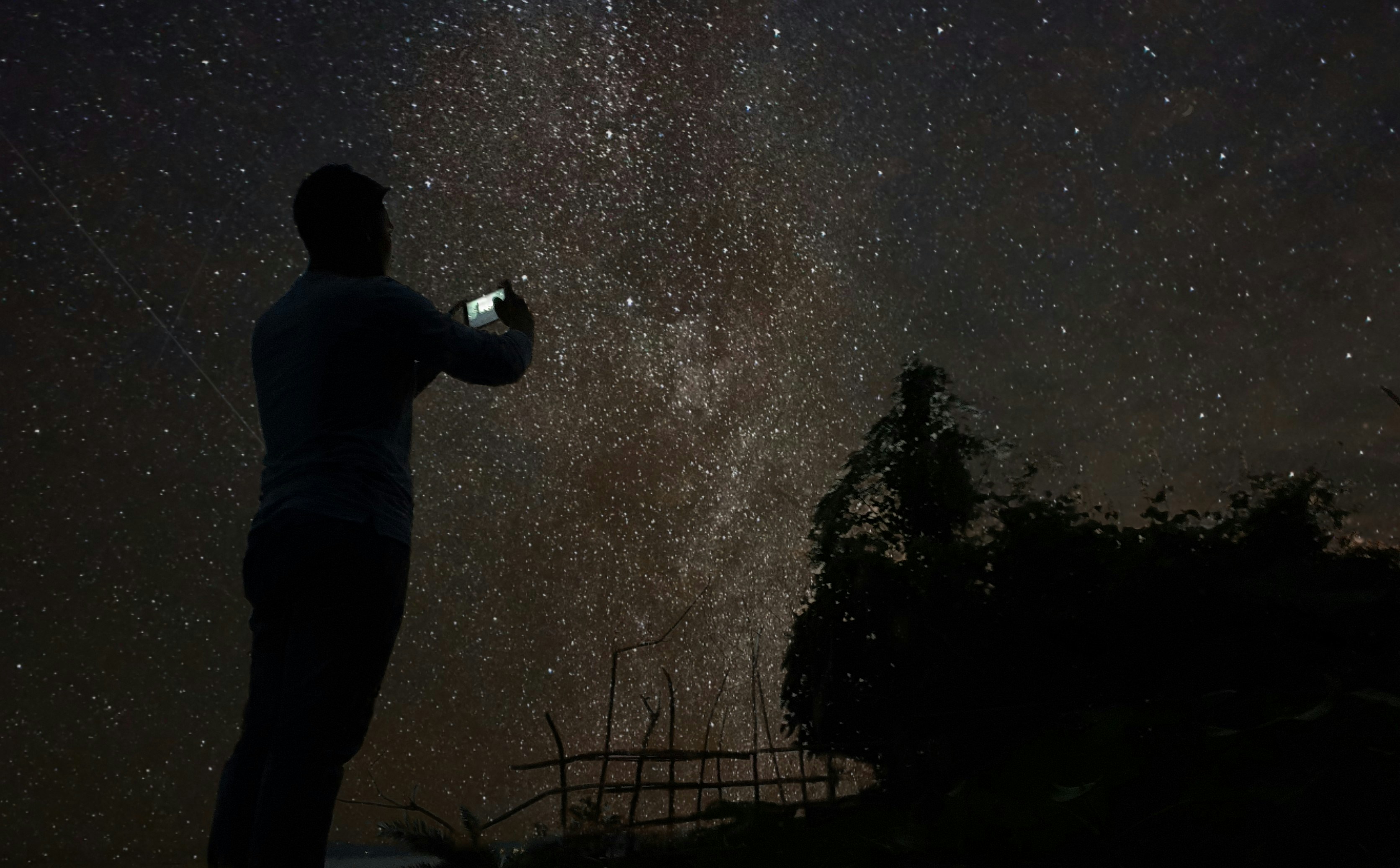
Neuroscientific research shows that experiences of awe—such as viewing the Milky Way—reduce activity in the brain’s default mode network, the system associated with self-focused thinking. When this network quiets, people often report feeling more connected to others and to something larger than themselves.
In practical terms, the stars literally help us step outside our own problems. This effect explains why astronomy is often linked to feelings of meaning, humility, and inspiration.
Scale, Time, and Cognitive Stretching
The universe forces the human brain to grapple with extreme scales of time and space. Light-years, cosmic inflation, and the age of the universe challenge intuitive thinking. Yet instead of rejecting these concepts, the brain stretches to accommodate them.
This cognitive stretching strengthens abstract reasoning—the same mental skill used in mathematics, philosophy, and systems thinking.
Curiosity as the Psychological Engine Behind Cosmic Exploration
At the core of our connection to the universe lies curiosity. The brain is wired to seek novelty, resolve uncertainty, and close knowledge gaps.
The Dopamine Loop of Discovery
When we encounter unanswered questions—such as what lies beyond our galaxy—the brain releases dopamine, motivating exploration and learning. Each discovery, from exoplanets to gravitational waves, reinforces this reward loop.
Astronomy is especially powerful because it continuously renews uncertainty. Every answer generates deeper questions, keeping curiosity alive across generations.
Why Space Questions Feel Different
Not all curiosities feel equal. Questions about the universe often touch on identity, origin, and destiny. These are existential themes that engage both emotional and rational brain systems, making cosmic inquiry uniquely compelling.
Culture, Myth, and the Storytelling Brain
Long before scientific astronomy, the stars lived in stories. The brain evolved to understand the world through narrative.
Myths as Early Models of the Universe
Ancient civilizations placed gods, heroes, and monsters in the sky. These myths transformed chaotic lights into structured meaning. While modern science replaced mythic explanations with physical laws, the storytelling impulse never disappeared.
Even today, space exploration is framed as a journey, a frontier, and a quest—narrative structures that resonate deeply with the human brain.
Science Fiction and the Collective Imagination
From early speculative novels to modern cinema, science fiction acts as a bridge between neuroscience and astrophysics. It gives the brain emotionally accessible models of otherwise abstract cosmic concepts. This blend of imagination and science keeps public interest in space alive even when real discoveries unfold slowly.
The Brain’s Search for Meaning in a Cosmic Context
One of the deepest reasons we look to the stars is the human need for meaning.
Existential Questions and Neural Comfort
The universe raises uncomfortable but unavoidable questions: Why are we here? Are we alone? Does anything last forever? These questions activate brain regions linked to self-reflection and moral reasoning.
Interestingly, cosmic awareness can both unsettle and stabilize us. Some people experience existential anxiety, while others find comfort in being part of a vast, orderly system governed by physical laws.
The Overview Effect
Astronauts often describe a profound psychological shift after seeing Earth from space. This “overview effect” leads to increased empathy, environmental awareness, and a reduced sense of personal ego. It demonstrates how cosmic perspective can physically rewire patterns of thought in the brain.
Technology as an Extension of the Cosmic Mind
Human tools have always expanded perception, but space technology represents the most dramatic extension of this process.
Telescopes as Cognitive Amplifiers
From Galileo’s first telescope to the James Webb Space Telescope, each leap in technology has expanded not only what we see but how the brain conceptualizes reality. Invisible wavelengths become visible. Distant galaxies become measurable.
This constant expansion keeps the brain in a state of productive tension between the known and the unknown.
Artificial Intelligence and Cosmic Data
Modern astronomy generates more data than humans alone can process. AI now helps identify patterns in star formation, galaxy evolution, and cosmic radiation. This partnership between human cognition and machine intelligence marks a new phase in how the brain engages with the universe.
Education, Childhood Wonder, and the Long-Term Impact on the Brain
The connection between the brain and the cosmos often begins in childhood.
Why Children Are Naturally Drawn to Space
Children show early fascination with planets, stars, and astronauts. This interest reflects the brain’s natural attraction to big questions and unfamiliar environments. Space provides a safe way to explore danger, distance, and mystery without immediate risk.
Long-Term Cognitive Benefits
Early exposure to astronomy strengthens spatial reasoning, mathematical thinking, and long-term interest in science. More importantly, it nurtures intellectual humility—the understanding that knowledge is always incomplete.
Are We Wired to Search for Other Minds in the Universe?
The search for extraterrestrial life is another powerful driver of cosmic interest.
The Social Brain Beyond Earth
Human brains evolved to detect other minds. This social radar does not stop at the edge of our planet. The possibility of intelligent life elsewhere activates the same neural circuits involved in social curiosity, empathy, and threat detection.
Loneliness, Hope, and Cosmic Companionship
For some, the idea of cosmic neighbors reduces feelings of isolation in an immense universe. For others, it introduces fear. Both reactions reveal how deeply emotional the scientific search for life truly is.
The Psychological Cost of Cosmic Awareness
While the stars inspire, they can also overwhelm.
Cosmic Insignificance and Anxiety
Awareness of humanity’s small size in an enormous universe can trigger feelings of insignificance or nihilism. This is especially true in individuals prone to anxiety or depression.
Why Most People Ultimately Find Balance
Despite these risks, long-term studies suggest that most people integrate cosmic awareness in a healthy way. The brain adapts by reframing insignificance as connection rather than meaninglessness.
The Future of the Brain–Cosmos Relationship
As technology advances, the relationship between human cognition and the universe will deepen.
-
Virtual reality will allow immersive cosmic experiences.
-
Brain-computer interfaces may one day help visualize complex cosmic data directly.
-
Interplanetary travel will redefine how the brain understands “home.”
Each step will further blur the boundary between observer and cosmos.
Key Takeaways
-
The human brain evolved to seek patterns, making the stars a natural focus of attention.
-
Awe triggered by the cosmos reshapes self-perception and emotional balance.
-
Curiosity and dopamine-driven learning fuel continuous interest in space.
-
Myth, storytelling, and science fiction bridge emotional and scientific engagement with the universe.
-
Cosmic awareness influences how we search for meaning and identity.
-
Technology acts as a direct extension of human perception into deep space.
-
The search for extraterrestrial life reflects the brain’s social wiring.
-
While cosmic scale can provoke anxiety, most people adapt with increased perspective and humility.
FAQ
Why are humans naturally fascinated by space?
Because the brain is wired for curiosity, pattern recognition, and meaning-making, all of which are powerfully stimulated by the cosmos.
Does looking at the stars really affect mental health?
Yes. Experiences of awe can reduce stress, quiet self-centered thinking, and increase feelings of connection and well-being.
Is interest in astronomy purely scientific?
No. It is equally psychological, emotional, cultural, and existential.
Why do children love space so much?
Space offers mystery, scale, and adventure—ideal ingredients for developing imagination and abstract thinking.
Does cosmic awareness make people more pessimistic?
For some, temporarily. For most, it ultimately fosters perspective, humility, and long-term emotional resilience.
Conclusion
Our fascination with the stars is not an accident of culture or technology—it is written into the architecture of the human brain. The cosmos activates our deepest cognitive systems: curiosity, awe, storytelling, social imagination, and the search for meaning. As we continue to explore the universe, we are also exploring ourselves. The further we look outward, the more clearly we understand the inner workings of the mind that keeps asking, again and again, what lies beyond.